Hi my faithful readers. It makes me happy, to see You all back here again in my blog. Today I will share my personal and also some professional experiences with You about the very beautiful country Ecuador, which lies in the nothwestern part of South America and has as neighbors in the north Colombia, in the east and south Peru and in the west the Pacific Ocean. The capital – but not it`s biggest city – of Ecuador is Quito, it`s main harbor city is Guayaquil, where also a great part of Ecuador`s industry is concentrated.
According to the historicians, the first indians arrived and settled in this country coming from far away in the north or on the land way through Central America or on boats along the coast of the Pacific Ocean about 15.000 years ago. Others might have much later arrived there coming through the Amazon. The Andes highlands of Ecuador became part of the Inca empire only in 1463, means two generations after the arrival of the first Incas in Ecuador, due to the fierce resistance of the highly developped native population.
Shortly before the arrival of the Spanish colonisators in Ecuador, a civil war broke out in the Inca empire after the sudden death of the emperor Huayna Capac and his young heir. This created a power vacuum between two factions. The northern part of Peru and Ecuador were reigned by Atahualpa from his capital Quito in Ecuador. The rest of the Inca empire was reigned by Atahualpa`s half-brother Huascar from his capital Cuzco in Peru. As nicely described in Wikipedia, Huáscar ordered Atahualpa to attend their father’s burial in Cuzco and pay homage to himself as the new Inca ruler. Atahualpa, with a large number of his father’s veteran soldiers, decided to ignore Huáscar, and a civil war ensued. A number of bloody battles took place until finally Huáscar was captured. Atahualpa marched south to Cuzco and massacred the whole royal family associated with his brother.
Soon afterwards, the Spanish arrived. In 1532, a small band of Spaniards headed by Francisco Pizarro landed in Tumbez and marched over the Andes mountains until they reached Cajamarca, where the new Inca (= emperor) Atahualpa was to hold a meeting with them. Valverde, the Spanish Dominican priest, who accompanied Pizarro during his enterprise in South America, tried to convince Atahualpa that he should join the Catholic Church and declare himself a vassal of Spain. This infuriated Atahualpa so much that he threw the Bible to the ground. At this point the enraged Spaniards, with orders from Valverde, attacked and massacred the unarmed escorts of the Inca and captured Atahualpa. Pizarro promised to release Atahualpa if he made good his promise of filling a room full of gold. But, after a mock trial, the Spaniards executed Atahualpa by strangulation.
The natives were forced into the “encomienda” labor system by the Spanish. In 1563, Quito became the seat of a “real audiencia” (administrative district) of Spain and part of the Viceroyalty of Peru and later the Viceroyalty of New Granada. After nearly 300 years of Spanish rule, Quito was still a small city numbering 10,000 inhabitants. On August 10, 1809, the city’s criollos called for independence from Spain (first among the peoples of Latin America). Quito’s nickname, “Luz de América” (“Light of America”), is based on its leading role in trying to secure an independent, local government. Although the new government lasted no more than two months, it had important repercussions and was an inspiration for the independence movement of the rest of Spanish America. August 10 is now celebrated as Independence Day.
On October 9, 1820, Guayaquil became the first territory in Ecuador to gain its independence from Spain, and it spawned most of the Ecuadorian coastal provinces, establishing itself as an independent state. It`s inhabitants celebrated what is now Ecuador’s official Independence Day on May 24, 1822. The rest of Ecuador gained its independence after Antonio José Sucre defeated the Spanish Royalist forces. Ecuador joined Simón Bolivar`s Republic of Gran Colombia, also including modern-day Colombia, Venezuela and Panama. In 1830, Ecuador separated from Gran Colombia and became an independent republic.
I am sharing this short and very much appreviated history of Ecuador until it became an independent nation with You because it gives us the full background for the rich culture and variety of arts, which we find today in this very beautiful country, the same as for the mixture of people with origins from the pre-inca, inca, spanish colonial and modern post colonial periods and immigrations.
But Ecuador is especially interesting for people who want to experience the exciting contrast of it`s totally different geographical and climate regions. “La Amazonia” or “El Oriente” (“the east”) contains the Amazon jungle provinces, where – by the way – the largest resources of petroleum of this country are located and beeing explored. “La Sierra” (“the highlands”) comprises the Andean highland provinces, which contain most of Ecuador`s volcanoes and all of it`s snow-capped peaks and where the country`s capital Quito is located at 2850 meters geographical hight. And finally “La Costa” (“the coast”), where Ecuador`s most fertile and productive land including the huge banana plantations are located and where most of Ecuador`s rice grop is grown.
I have visted Ecuador for the first time at the end of the year 2000. At this time I had just completed my first year as Managing Director of Schwarzkopf & Henkel`s famous cosmetics company “La Toja” in La Coruna, Galicia, Spain. After my arrival and a first week in the very beautiful capital Quito with it`s rich historical center I rented a car and drove from there on the mountains to Ambato, made a short visit to Baños, a quite small town, which is beeing considered as “the gateway to Amazon”. From there I continued further to Riobamba, which is close to the 6268 meters high and snow covered Chimborazo, Ecuador`s highest mountain. My travel down the Andes took me finally to the harbor city of Guayaquil, which besides concentrating a great part of Ecuador`s industry, is by far it`s biggest city, where more than 2 of the in total 17 million Ecuadorians live today. From there I continued through the coastal harbor cities Salinas (some Ecuadorians like to titulate it their “Miami”) and Manta (wellknown for it`s tuna fishing industry) until Esmeraldas, an important port in the north of Ecuador, less than 200 kilometers away from the Colombian border. My way back “home” to Quito led me through Santo Domingo (de los Colorados), Ecuador`s fourth biggest city and then up the incredibly beautiful and exciting mountain roads.
I can highly recommend Ecuador for all those of You, who would like to experience personally within a relatively short time – I think three weeks serve perfectly – the unbelievably beautiful Andes region and the rich in contrast, totally different in all dimensions, coastal and Amazon forest worlds. I have not mentioned here the famous Galapagos islands, which also belong to Ecuador and find themselfes about 900 kilometres west of Ecuador in the Pacific Ocean, just for the reason, that I did not find the opportunity so far, to visit these.
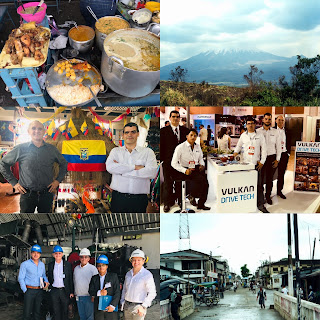
Since my private, purely touristic visit at the end of 2000, I have in the meantime returned to Ecuador for professional reasons several times. When Arno Ett (+55 11 99512 4929, arno.ett@vulkan.com), Sales Director Vulkan Drive Tech (all kinds of couplings, brakes, backstops and mounts for all kinds of industrial mechanical power transmission applications) and I started to develop our sales expansion project allover Latin America five years ago from out of our factory in Itatiba, Sao Paulo, Brazil, we also had a deep look at Ecuador. Today Vulkan do Brasil`s industrial division Vulkan Drive Tech (VDT) is beeing represented there by our local distribution partner Marco Ecuador (
http://marco.com.ec/index.php/es ), where our friend and partner Esteban Guano and his great team of colaborators work closely together with Arno Ett and Andre Nunes, Sales Manager Vulkan Drive Tech. Actually our colleague Andre Nunes (+57 317 772 0651, andre.nunes@vulkan.com) attends the ecuadorian market from out of our office and sales subsidiary Vulkan Drive Tech Colombia in Bogotá, Colombia, within what we internally call the “northern cluster”, means Colombia, Ecuador, Peru and Bolivia.
Arno and I have developped and set up – with great support from several other brazilian management teams colleagues – our “cluster” structure for the whole Latin America region incl. Mexico, Central America, Caribbean and all South America (with the only exception of Brazil, which we manage seperately) at the beginning of 2015, when we started our market expansion project in Latin America, and since then this works perfectly until today.
Since we got started to introduce actively our products and services to Ecuador, we have participated in several events organised by the German – Ecuadorian Chamber of Commerce and Industry , AHK Ecuador, (
http://marco.com.ec/index.php/es ). At this place I would like to send a warm embrace to our great friends Ulrieke Stieler, Manager DE International @ AHK Ecuador, and Jörg Zehnle, Managing Director of AHK Ecuador, and thank them for the always very friendly and open reception and for the great support during all our joint activities in Ecuador, like f.e. our participation in the german mining equipment supplier delegation to Ecuador two years ago.
I hope, all this has made You curious for personally getting to know Ecuador, it`s really rich history, culture, arts, kitchen, beautiful landscape in the totally different geographical and climate regions and – last not least – it`s wonderful friendly people.
My music recommendation for today, which fits nicely to this post is a sample of Lucho Quequezana`s compositions and presentations. Although Lucho Quequezana is Peruvian and not Ecuadorian, his creative fusion of traditional andean music styles and instruments with modern music styles incl. european classical music, finds great interest allover Latin America.
See You here again tomorrow hopefully. Enjoy the remaining weekend hours and get strongly started for the new exciting week tomorrow.







I need to share this wonderful comment upon my today`s post with You, which my friend Andreas Voss, Head of Legal Mexico & Cuba/ Associate Partner @ Roedl & Partner, just wrote to me from Havanna, where he lives and works since 3 years (before this Andreas lived and worked for 5 years in Mexico): "Guten Morgen Herr Hepp, habe gerade Ihren Blog zu Ecuador gelesen. Toll geschrieben, macht richtig Lust auf einen Besuch! – Good morning Mr. Hepp, I have just read Your blog about Ecuador. Nicely written it provokes desire for a visit!" 1000 thanks Andreas ! Take care in Havanna.